Professional Development
As Teaching and Learning professionals…
We know that effective Teaching and Learning is arguably the most important aspect of school life that can make a difference to students’ lives. We know that high-quality teaching can narrow the disadvantage gap. Thus, teaching is our core business and every lesson at CAN is important.
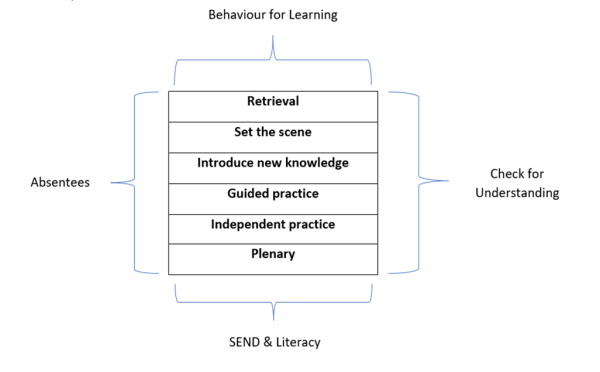
Research is constantly evolving, and we are all learning and developing throughout our career. To allow staff to develop more defined aspects of their own teaching, we have created an evidence-informed framework that will support the implementation of key features of effective teaching and learning, where the definition of ‘effective’ is having a positive impact on assessed learning.
We underpin our approach to the development of teaching and learning with the concept of ‘connectedness and the knowledge that “when there is a sense of belonging, we all improve” (Ryan and Deci, 2000). We understand that “sustainable change only happens when everyone is working together towards a shared goal” (Leithwood et al. 2019). Thus, we have developed a ‘CAN Core Framework’ that incorporates research from a variety of academic sources to provide a robust central pillar for learning across the academy. To compliment this, we have a set of shared strategies implemented across the school in all lessons so that students receive a consistently good experience of learning.
Through our whole school reciprocal coaching model, we also collaboratively support each other to build our mental modals and pedagogical toolkits, allowing staff to precisely identify areas of development within their own practice and have access to the necessary research informed CPD to make those improvements. This means that whilst our ‘CAN Core Framework’ and shared strategies underpin our expectations of effective teaching across the academy, our staff are equipped to use their professional judgement in utilising other known pedagogical strategies to ensure all students achieve and progress.
Thus, the culture across the academy is one of lifelong learning, both for students and for staff, and by providing a robust framework of expectations and shared strategies alongside regular opportunities for reflection and professional development, CAN will become a hub of educational achievement.
CAN's Pedagogical Framework
Coaching at CAN
Our approach to staff development is underpinned by the principles of instructional coaching and involves teachers working in pairs or small groups to deliberately practice pedagogical strategies in a low-stakes environment. This is achieved through deliberate practice in whole staff CPD sessions and through a whole school reciprocal coaching model.
Our reciprocal coaching model involves staff being organised into pods and within each pod teacher-pairs that take it in turns to coach one another. These sessions are 45 minutes in length, occurring for three consecutive weeks and at four points in the year (half term 1, half term 3, half term 5 and half term 6). We aim for a balance between embedding whole school strategies and opportunities for staff to work on specific areas of their own practice. All coaching sessions are documented on Steplab so staff have a comprehensive record of their professional development.
Each pod consists of 8-10 teaching staff, one of whom is the lead coach responsible for facilitating the sessions. The sessions provide an opportunity for staff to reflect on the strengths and areas of development in their current practice within the framework of CAN expectations as well as wider pedagogical approaches. Staff take it in turns to drop into each other’s lessons and coach one another. We follow the Ambition Institute coaching sequence to ensure feedback to one another is developmental:
- Praise
- Probe
- Precise Action Step
- Prime
- Practice
- Plan next steps
ITT and ECTs are not included in our reciprocal coaching programme as they are already following their own mentoring processes. Instead, they may use this directed time to complete university work, upload evidence to their online portfolios, and prepare for lessons.
Oversight for the reciprocal coaching model is with the Assistant Headteacher for Teaching and Learning, who meets with the lead coaches once per half term to plan sessions and ensure that coaching is implemented effectively.
Department / Subject-Specific
During Leader of Department (LOD) meetings (which occur on alternate Tuesdays), the Deputy Headteacher for Curriculum and Assistant Headteacher for Teaching and Learning work collaboratively with LODs to devise Department / subject CPD plans. This includes external providers delivering training as well as planning effective use of department time. All Department time is an opportunity for teams to refine curriculum and lesson plans, increase subject knowledge and share good practice.
SSAT / EFA Programme
In 2025 we completed the two-year SSAT Embedding formative assessment programme. This programme is nationally recognised and provides valuable resources and guidance on improving our use of formative assessment in the classroom. This work directly informed ad continues to underpin our approach to assessment.